
How Municipal Court Warrants Work
That "City Court Warrant" label is misleading for Hartford County, since no city criminal court here issues warrants of its own. Criminal and motor-vehicle cases across the state land in Superior Court Geographical Area locations, the GAs. A judge or judge trial referee signs appropriate process there under the court record and the law. Municipal police departments enforce that process and hold police records, but they cannot stand in for the Superior Court clerk.
Direct answer: Hartford County has no separate municipal criminal court; use the Connecticut Superior Court site named on the docket.
That line saves you time. A site selling a Hartford County sheriff or municipal-court warrant database does not fit how Connecticut actually runs its courts.
Hartford County City Police Are Not Courts
A city police department in Hartford County can serve criminal process, run a query on the restricted Paperless Arrest Warrant Network, file an arrest report, and answer a records request within its exemptions. What it cannot do is stand in for the judge or the clerk. The judge issued the order; the clerk keeps the file. So a call to a Records unit for an incident report is not the same as asking an authorized agency about a live warrant status.
| Question | Correct holder | What the route can do |
|---|---|---|
| Court order or docket | Superior Court clerk | Provide public case context and office procedure |
| Operational warrant status | Authorized police agency or issuing court | Explain its verified inquiry route |
| Police report | City police Records unit | Process an existing-record request |
| Civil capias | Issuing civil court unit and State Marshal route | Address separate civil process |
Municipal Courts Across Hartford County
No Hartford-area city or town runs its own criminal court. Each one routes into the Connecticut Superior Court network instead. Which courthouse takes a case turns on where the incident happened, the case type, and the docket. When in doubt, let the directory and the clerk decide the route for any Hartford County warrant question.
| Municipality | Criminal court route | Municipal police role |
|---|---|---|
| Hartford | Usually GA14, 101 Lafayette Street | Police execution and city records |
| West Hartford | Hartford-area Superior Court | Police execution and town records |
| New Britain | GA15, 20 Franklin Square | Police execution and city records |
| Bristol | GA17, 131 North Main Street | Police execution and city records |
| Manchester | GA12, 410 Center Street | Police execution and town records |
The table only routes you. It cannot confirm that a warrant exists or that a named court still holds a file in Hartford County.
Hartford City Uses GA14 and Community Court
Hartford GA14, at 101 Lafayette Street, handles most criminal and motor-vehicle routing for the city. The Judicial Branch directory lists 860-566-1630 for the clerk and public-information office, with extension 3032 for the public information desk. Hartford Community Court sits at 80 Washington Street, and its clerk answers at 860-756-7020. The Hartford Judicial District at 95 Washington Street covers civil, family, and other JD functions.
Those names point to different Superior Court sites with different jobs. "Community Court" is not a "Hartford Municipal Court," and calling it that will send you to the wrong place. Use the location printed on your docket, then confirm current phone and access details through the Judicial Branch directory. The judicial marshal office at a courthouse is its own operational contact, not a public Hartford County warrant search.
Hartford County Municipal Warrant Checks
No municipal criminal-court portal exists, so a Hartford County warrant check means a short official chain. Start with the public Judicial Branch lookup, which can surface docket context. The right clerk can then explain public entries and current procedure. Police with authorized access can query PRAWN, but that restricted network is closed to the public.
- Identify whether the issue is criminal, motor vehicle, civil capias, or merely a police report.
- Use the official case lookup to find the docket and court location when publicly available.
- Call the relevant Superior Court clerk through the current directory.
- Ask the municipal police agency for its live-status procedure only if police confirmation is needed.
- Speak with counsel before a voluntary appearance when custody or bail is possible.
A blank court screen is not a clearance certificate. Sealed, erased, juvenile, older, or newly filed matters may not display, so only the issuing court can confirm whether a Hartford County warrant truly stands.
City Records Requests Do Not Confirm Warrants
A records request under the Connecticut Freedom of Information Act asks a public agency for files it already holds. That is its limit. The law never forces a city to build a warrant database, do legal digging, or vouch that a warrant is still live beyond what its own records can show. So frame the request tightly. Name the agency, give a date range, add an incident or report number, and describe the existing record you want. Expect lawful copying fees, plus review for redaction or exemption before anything is released.
Hartford Police Records sits at 253 High Street and lists 860-757-4150. Copied pages run $0.50 each, and requests take a minimum of 7 to 15 business days after the incident. West Hartford, New Britain, Bristol, and Manchester all publish their own records contacts and rules. What any of them hand back stays a local record check, never a PRAWN or statewide warrant check. A Hartford County requester might get a redacted page, a slow answer, or nothing responsive at all, and still not learn whether a warrant is active right now.
Municipal Warrants: What They Show
None of these Hartford County cities issues its own municipal criminal warrant instrument. Whatever record exists comes from the Superior Court, an authorized law-enforcement system, or a city police file. The fields shift with the record type and your access to it. No single web screen gathers every detail in one place.
- Court and docket
- The Superior Court location and case identifier.
- Process type
- Arrest, bench, rearrest, or another court-authorized order.
- Responsible agency
- The law-enforcement unit associated with execution.
- Issue and action dates
- Order, execution, return, recall, or disposition dates where releasable.
- Access status
- Public, redacted, sealed, juvenile, erased, or otherwise restricted.
The aggregate OPM Arrest Warrant Data reports do count warrants by Hartford County municipality and category, including FTA and violation of probation. They never identify a person.
Hartford County Public Defender Routing
Suspect a criminal warrant in Hartford County and want advice before walking into a courthouse or police station? The clerk can explain public entries and process, though not strategy or likely release terms. The Office of the Chief Public Defender lists a Hartford office at 55 Farmington Avenue, eighth floor, Hartford, reachable at 860-509-6400. Eligibility and representation follow official procedures. The Office of the Chief Public Defender contact page is the source for those details, and it also carries an important bail-scam warning.
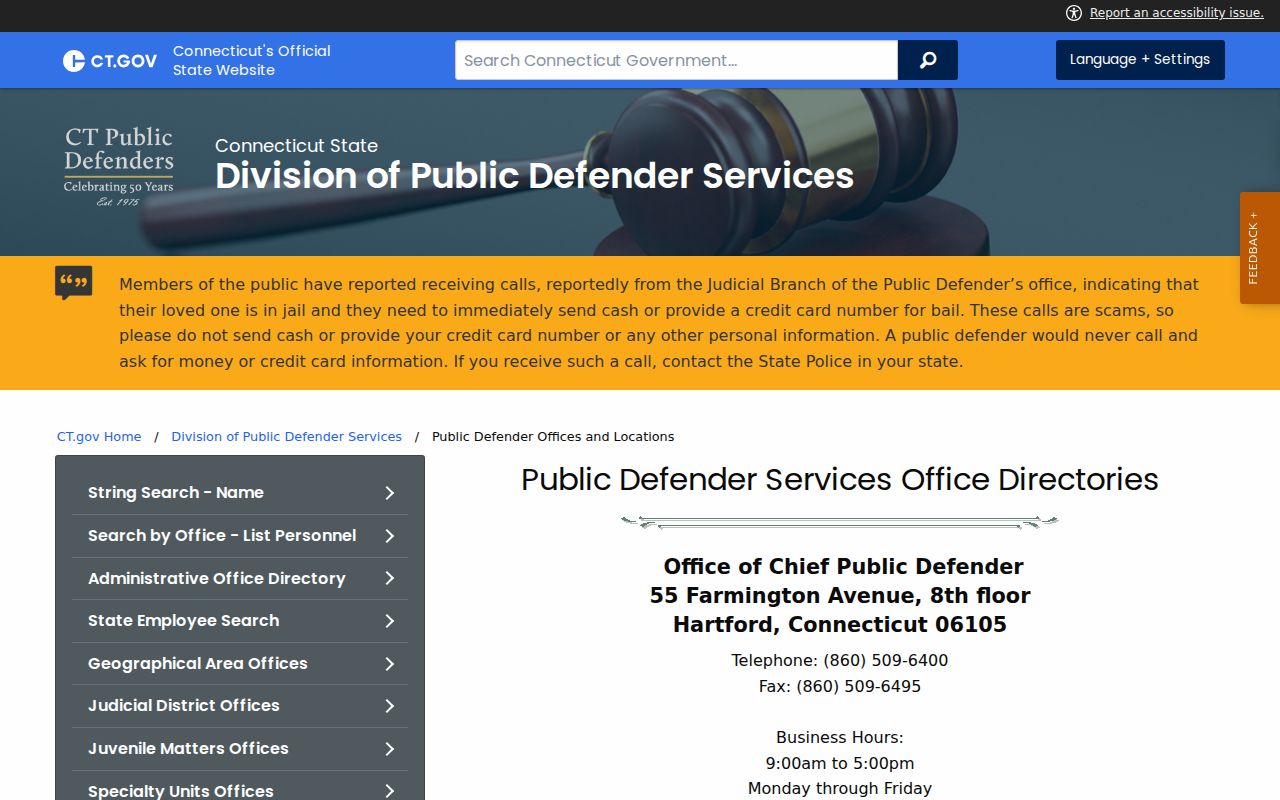
Hartford County's public defender office does not make calls demanding bail money. Hang up on any caller in Hartford County who claims a city warrant requires instant payment.
Clearing a Municipal Court Warrant
Hartford County has no separate municipal criminal court, so no municipal recall process exists there. The Connecticut Superior Court that issued the process handles everything. Its procedures vary by file: a calendar, a motion, an appearance, surrender, bail, or payment. The clerk, the judge, or your counsel can say what fits the current case.
- Replace the “municipal court” label with the actual GA or JD shown on the record.
- Confirm current status and procedure through the issuing clerk or authorized agency.
- Ask counsel whether a motion, appearance, or surrender step is appropriate.
- Handle any traffic, DMV, or civil consequence through its separate official route.
- Retain the court's confirmation rather than relying on an online payment receipt alone.
Do not assume: Paying for a city police report or local record check does not recall a Superior Court warrant.
Hartford County Civil Capias Takes Another Route
A civil capias, or capias mittimus, is enforcement of a court order. It often grows out of a family-support proceeding or a failure to appear after civil process. State Marshal materials stress one point: this is not simple arrest for failure to pay. State marshals may execute certain civil capias orders statewide under defined rules. That makes it different from a criminal arrest warrant, which police execute. Hartford County residents with questions should start with the issuing Superior Court's civil or family-support unit, their counsel, or the State Marshal Commission. The Commission FAQ lists 860-713-5372 for general contact and complaints. Hartford County publishes no public capias database. A city police records request cannot clear one of these orders. Execution authority can reach state marshals statewide, constables within defined local authority, and judicial marshals in custody or courthouse settings. Even that list does not turn the order into city criminal process. The issuing civil docket is still the best routing key for any Hartford County capias question. Ask which court unit signed the order, whether a public copy exists, and which authorized officer holds it. Do not search for a municipal warrant counter that Connecticut does not operate. And never treat a city page label as a reason to merge criminal warrants, traffic cases, and family-support capias into one local product.