
How Traffic Warrants Work in Hartford County
Skipping a required step is what pushes a Connecticut ticket toward a warrant. Pay, plead, or appear on time and most matters stay routine. What follows a missed deadline depends on the charge, the response, the court record, and the notice sent. Some tickets stay with the Centralized Infractions Bureau, or CIB, from start to finish. Others move to a Superior Court GA. A missed response can bring a failure-to-appear consequence, a court warrant, a DMV suspension request, or several of those at once. Hartford County has no county traffic court and no sheriff warrant counter. Connecticut runs one Superior Court system instead. Hartford matters usually land at GA14. Depending on the town, other cases route to GA12, GA15, or GA17. The ticket's location and docket control the answer, not the driver's home address.
CIB ePay Is Not a Hartford Warrant Search
The CIB ePay portal is the state's official route for paying eligible tickets. Its landing screen asks for ticket or complaint details. It locates payable matters only. That makes it no name-based warrant search for Hartford County, and it shows no live PRAWN status or proof that court consequences have ended. Any warrant, calendar, or recall question goes to the assigned court instead. The CIB ePay page is where the state posts that ticket-payment interface.
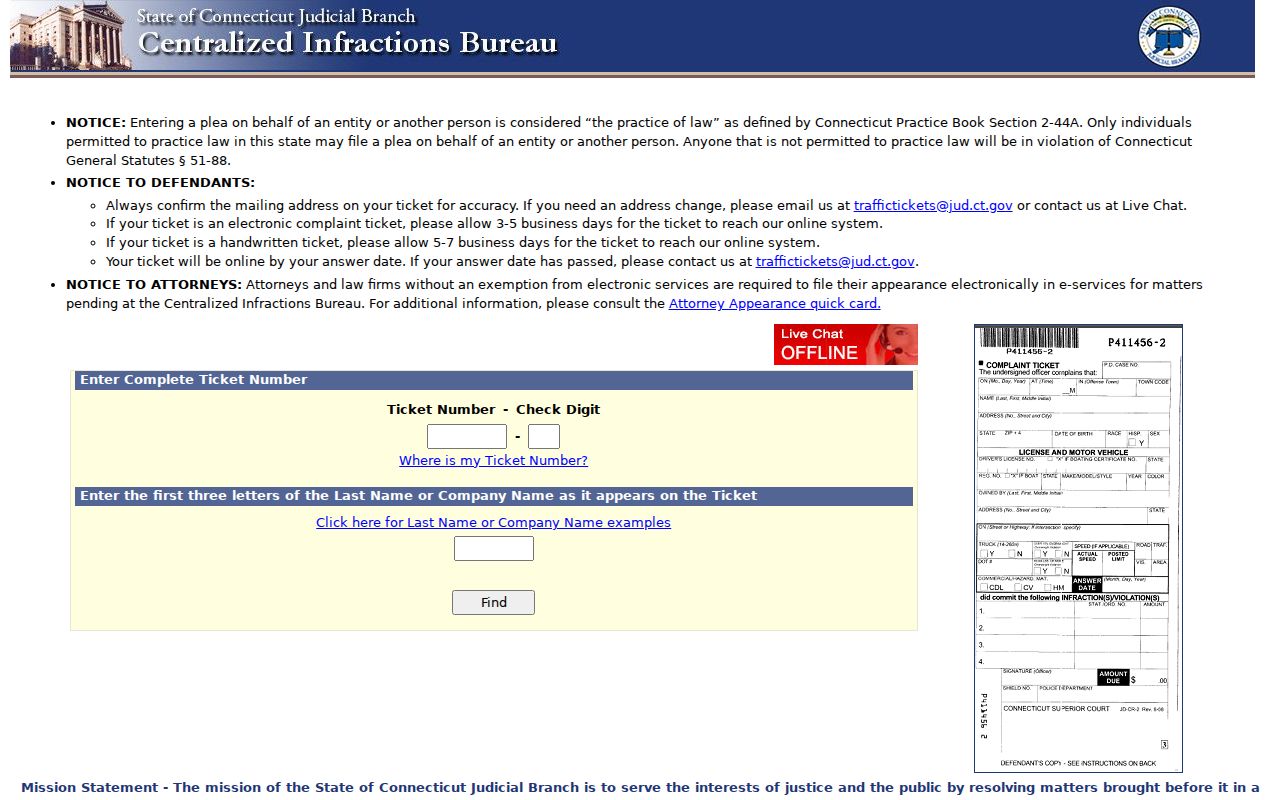
Use the state portal for the ticket transaction it offers. Then take any Hartford County warrant, calendar, or recall question directly to the assigned court.
Hartford County Traffic Warrant Checks
Begin with the paper or electronic notice. It names the citation, the response steps, and the right court channel. If the matter appears in the Judicial Branch pending criminal and motor-vehicle lookup, write the docket and location down for the clerk. A public search result in Hartford County is context, not a definitive warrant status.
- Read the citation and identify its response date, number, and official state route.
- Use CIB or the listed court to learn whether the ticket remains eligible for that process.
- Check the Judicial Branch lookup for public docket context if the case has reached court.
- Call the correct criminal/motor-vehicle clerk to ask about current court procedure.
- Contact DMV separately if a suspension or reinstatement notice exists.
A police records request is a separate channel. It can return an incident or citation record, but a Hartford County police file is no active-warrant certification.
Missed Hartford Traffic Date: What to Do
A missed traffic date is fixable, but not by assumption. Do not treat a fast online payment as a cure for everything. First find out who holds the file. Ask whether it is still with CIB or has been referred to a GA court in Hartford County. The clerk can say whether a new date, a plea, payment, an appearance, or a motion applies. If criminal consequences are possible, get legal advice before you appear.
Quick route: Find the ticket court, verify the current case status, then handle the court and DMV parts as separate obligations.
Keep every receipt and court confirmation. A payment receipt is not a warrant-clearance certificate unless the issuing court confirms the Hartford County order's end.
Traffic Warrants: What They Show
Traffic-related court records vary widely. Each one shows different fields. A public docket, a citation record, a police file, a restricted warrant record, and a DMV notice do not expose the same things, so Hartford County descriptions should name fields carefully and never print a real person's number.
- Citation number
- A case-specific identifier, shown here only as SAMPLE-TICKET.
- Court location
- The CIB or GA route assigned to the matter.
- Response event
- Payment, plea, hearing, referral, or failure to respond.
- Warrant action
- Issue, execution, recall, or other court disposition where applicable.
- DMV consequence
- A separate suspension request or reinstatement status.
Not every field is public or online. PRAWN remains restricted to authorized criminal-justice agencies.
Hartford County Court and DMV Tracks
A court warrant and a DMV suspension are separate records. Different offices control them. They connect only when the governing process links them. Clearing a Hartford County court obligation may still require proof or notice to reach DMV before a license status changes. Working a DMV reinstatement step, likewise, does not dispose of an open court order.
| Track | Agency | Question to ask |
|---|---|---|
| Citation response | CIB or listed court | Is the ticket still eligible for this route? |
| Court warrant | Issuing Superior Court | What current appearance or recall process applies? |
| Operational status | Authorized police or court route | How is current status confirmed? |
| License consequence | Connecticut DMV | What reinstatement step remains after court compliance? |
Log every call. Write down the office, the date, and the instruction given. That simple log separates a Hartford County court action from a later DMV update and gives the clerk or counsel a clear sequence if the two records disagree.
Clearing a Hartford County Traffic Warrant
Only the issuing court controls its own warrant. No single fix fits every Hartford County case. The clerk's current instructions decide whether a payment option, a new date, a voluntary appearance, or a motion applies. Get counsel when the charge or a likely custody consequence calls for it.
- Confirm the court and citation or docket number through an official source.
- Ask whether the matter requires payment, plea, court appearance, motion, or counsel.
- Follow the court's instructions and obtain its disposition or confirmation.
- Complete any separate DMV reinstatement requirements shown on the official notice.
- Recheck status through the responsible official office, not an unofficial ticket site.
Caution: Court compliance and DMV reinstatement may move on different timelines, so verify both before assuming the matter is complete.
Hartford County Ticket Payment Scams
Connecticut DMV posted a warning on March 6, 2026. Fake calls and texts were demanding payment for unpaid traffic citations, and Hartford County drivers saw them too. DMV does not send traffic-citation payment demands by text. A scam message stirs fear of instant suspension or arrest. Then it pushes a link to a page that is not the agency's real payment site. Do not click that link. Never reply with personal or financial details either. Type ct.gov or the Connecticut Judicial Branch address yourself. Compare the citation against the official portal. Call the Hartford County court or DMV on a published number. The DMV notice also points to FTC reporting, which is worth following. Stay wary even when the sender knows a real name, town, or ticket detail. A genuine citation can serve as bait, so keep the text as evidence and let no countdown, threat, or odd payment method replace direct confirmation from Hartford County officials.
How Traffic Warrants Trigger License Holds
In Hartford County, ignoring a traffic ticket can do more than annoy a judge. The court can ask DMV to act against the license, and once that happens two records govern two separate things. The court file answers whether a warrant stands. DMV's file answers what the license needs to come back. Neither a warrant check nor a driving-history site replaces those official records. The Connecticut DMV license suspension page spells out the reinstatement route and any consequence now in force. Fees shift over time, so confirm the current amount with DMV instead of trusting an old notice. After a Hartford County court reports compliance, ask DMV exactly what proof it wants and how long the update takes.
Hartford County Traffic Court Routing
Hartford GA14 sits at 101 Lafayette Street, Hartford, CT 06106, and the directory lists 860-566-1630 as the clerk and public-information line. Traffic cases do not all land there. Manchester routes through GA12 at 410 Center Street, New Britain through GA15 at 20 Franklin Square, and Bristol through GA17 at 131 North Main Street. West Hartford generally runs through the Hartford-area Superior Court structure. Before any trip, check the assignment printed on the citation or docket itself. The Hartford County city court warrant route explains why none of these courts is a municipal criminal court, which matters when a traffic ticket has grown into an outstanding warrant. A city police traffic unit may hold a police record or pass along a local contact, but it cannot replace CIB or the clerk at the assigned Superior Court. Call ahead or verify the current directory, since office hours, security rules, and accessibility instructions change without notice. When you go, bring the citation, the docket number if one exists, and whatever identification the clerk requests. Ask plainly whether the matter is still centralized, has been transferred, or now requires an appearance. If the clerk points you to a different GA, follow the record rather than the county label, especially for a ticket written outside Hartford or a case that moved. When the web portal is not an option, the clerk's telephone and public-information channels are the fallback; the office can explain where a public record sits and how a current procedure works, though it cannot give legal advice. If an appearance could lead to custody, talk to counsel before picking a date or place based only on a web entry.